The Complete 4 Bet Strategy Guide for Winning at Online Poker 2026
On This Page
- Understanding the 4 Bet: Core Mechanics and 2026 Meta Shifts
- When to Pull the Trigger: Range Construction and Player Profiling
- The 4bet Platform Advantage: Where to Execute Your Strategy in 2026
- Step-by-Step: Building Your 4 Bet Arsenal
- Pros and Cons of the 4 Bet Strategy
- FAQ: 4 Bet Strategy for 2026
Three-betting used to be the power move. Now everyone does it. The real edge in 2026 online poker comes from knowing exactly when to fire that fourth bet — the re-raise that separates the crushers from the callers. A well-executed 4 bet strategy forces opponents into impossible decisions, folds out marginal hands, and builds pots where your range advantage is overwhelming. Whether you're grinding micro-stakes cash games or navigating deep runs in online tournaments, mastering this weapon transforms your win rate from break-even to dominant.
The mechanics are simple. The execution is not. A 4-bet occurs when you re-raise after an opponent has already 3-bet your initial open. It screams strength — or at least it should, when used correctly. The problem most players face in 2026 is that the games have gotten tougher. Regs at even the lowest stakes understand balancing. They know when you're capped. They exploit predictability. So your fourth-bet frequencies, your sizing, and your bluff selections need to be sharper than ever.
Understanding the 4 Bet: Core Mechanics and 2026 Meta Shifts
Poker evolves. What worked in 2026 gets you crushed in 2026. The meta has shifted toward smaller, more frequent three-bets from in-position players, which means the counter-strategy — your four-bet game — needs to adapt accordingly.
The Fundamentals
A 4-bet happens in this sequence:
- Player A opens with a raise (2.5x–3x)
- Player B 3-bets (to roughly 9x–12x)
- Player A 4-bets (to roughly 22x–28x)
That final action is your four-bet. It commits significant chips, signals a polarized range, and puts the 3-bettor to a brutal test. They either fold, call with a capped range, or jam with a narrow value subset.
Why 2026 Is Different
The online poker landscape this year is defined by a few key trends:
More players study with GTO tools. Their 3-bet ranges are tighter and more balanced than two years ago.
Three-bets to 2.8x–3.2x in position are now standard. This means your 4-bet sizing should also shrink — a 2.2x–2.5x four-bet is often optimal rather than the old-school 3x.
Faster blind structures in 2026 online MTTs mean ICM pressure hits earlier. Four-bet shoving becomes a critical skill in the 20–40 big blind range.
The players winning the most in 2026 aren't the ones who four-bet the most. They're the ones who four-bet the right hands against the right opponents at the right frequencies.
Value vs. Bluff: The Polarized Approach
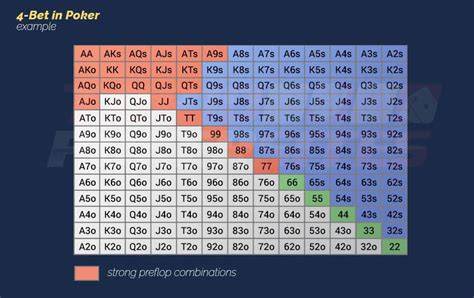
Your four-bet range should be polarized — meaning it consists of your strongest hands (for value) and a select group of hands with good blockers (as bluffs). The middle of your range — hands like AQo, KQs, 99 — often performs better as a call. They're too strong to fold but not strong enough to four-bet for value.
Value four-bet range (typical 6-max cash):
- ✔ AA, KK, QQ, AKs, AKo
- ✔ Sometimes JJ, AQs depending on the opponent
Bluff four-bet candidates:
- ✔ A5s, A4s, A3s (ace blocker is king)
- ✔ K9s, K8s occasionally (king blocker reduces their KK/AK combos)
Key Concept
The ace blocker is the single most important concept. When you hold an ace, you reduce the opponent's AA, AK, and AQ combinations by 25–50%. That makes them far more likely to fold their bluffs and marginal value hands.
Top Poker Platforms for 2026
4bet
Up to $500 Bonus
- Highly soft, recreational-heavy player pool
- Fast withdrawal processing and transparent terms
- Competitive rake structure for cash games
Bet365
Up to $300 Bonus
- Medium player pool softness
- Standard rake and fast withdrawals
- Reliable platform with strong reputation
Betway
Up to $250 Bonus
- Medium player pool with steady traffic
- Standard rake structure
- Good mobile app for grinding on the go
When to Pull the Trigger: Range Construction and Player Profiling
A four-bet is never played in a vacuum. It lives or dies based on who's sitting across from you. The same hand can be an auto-four-bet against one opponent and an auto-fold against another.
Player Types and Adjustments
The Wide 3-Bettor (LAG, high 3-bet frequency 12%+)
This is your dream opponent. They're 3-betting light from the button and cutoff with hands like A7s, K9o, 76s. Your response? Expand your value range to include JJ, TT, AQs, and mix in more bluff four-bets with ace-blocker hands. Their wide range means they miss the flop often, and they'll fold to continued aggression.
The Nit (3-bet frequency 5% or less)
Against a player who only re-raises with JJ+, AK, your four-bet bluffs lose tremendous value. They simply won't fold. Against this opponent, tighten your value range to just AA, KK, and maybe QQ. Drop the bluffs entirely. If you four-bet AKo here, you're turning a profitable call into a losing raise.
The Reg Who Knows GTO
This is the tricky one. A balanced regular 3-bets around 7–9% from the button with a mixed strategy. Against them, you need to play closer to solver-optimal frequencies. Four-bet around 15% of your opening range, with a value-to-bluff ratio of roughly 60:40. Track their tendencies — even GTO-influenced players have leaks. Many over-fold to four-bets out of position, which means you can increase your bluff frequency.
Position Matters Enormously
| Position Dynamic | 4-Bet Frequency | Notes |
|---|---|---|
| BTN vs BB 3-bet | 12–15% | Button opens wide, BB 3-bets polarized. You can four-bet bluff more. |
| CO vs BTN 3-bet | 10–13% | Slightly tighter cutoff range. Balance is key. |
| UTG vs MP 3-bet | 6–8% | UTG is already tight. Four-bet mostly value. |
| SB vs BB 3-bet | 18–22% | Blind vs blind is a war. Expand both value and bluffs. |
The small blind versus big blind dynamic deserves special attention. In 2026, many online games see aggressive blind-vs-blind play. The BB 3-bets wide. The SB should four-bet with an expanded range — including hands like KTs, QJs as light value, and more suited ace bluffs. This is one of the most profitable spots in the game if executed correctly.
Stack Depth Changes Everything
At 100 big blinds, you have room to four-bet and fold to a jam. At 40 big blinds, a four-bet pot-committing size essentially forces a shove-or-fold dynamic. At 20 big blinds, you should often skip the four-bet and just open-jam or call-shove.
- 100bb deep: Standard 2.2x–2.5x four-bet. Fold to a jam with your bluffs. Call with your value.
- 40–50bb deep: Four-bet to a size that commits you. Jam with your value. Bluff less — fold equity drops when opponents know you're committed.
- 20–25bb deep: Four-bet shoving becomes a weapon. Especially in tournaments with ICM pressure. A 22bb shove from the cutoff over a button 3-bet with A5s is a profitable play against most ranges.
The 4bet Platform Advantage: Where to Execute Your Strategy in 2026
Where you play matters as much as how you play. The platform determines your opponent pool, the rake structure, the bonus economics, and ultimately your bottom line. In 2026, 4bet has positioned itself as a serious destination for poker players who want soft games, fast payouts, and bonus structures that actually support a winning player's bankroll growth.
Why 4bet Stands Out
The poker ecosystem on 4bet is built around player value. Cash game traffic runs consistently across No-Limit Hold'em and Pot-Limit Omaha tables, with stakes ranging from micro to high. The player pool skews toward recreational and casual depositors — exactly the kind of opponents who 3-bet too wide and fold too much to four-bets.
Community feedback highlights several strengths players consistently praise:
- Fast withdrawal processing — cash outs hit accounts quickly, which matters when you're managing a bankroll across sessions
- Transparent bonus terms — the rollover requirements are clearly stated, not buried in fine print
- Responsive mobile play — the platform runs smoothly on mobile, critical for players grinding on the go
- Soft cash game tables — the recreational traffic creates profitable conditions for skilled players
How 4bet Compares to Other Platforms in 2026
| Platform | Player Pool Softness | Rake | Withdrawal Speed | Bonus Value |
|---|---|---|---|---|
| 4bet | High (recreational-heavy) | Competitive | Fast | Excellent |
| Bet365 | Medium | Standard | Fast | Good |
| Betway | Medium | Standard | Moderate | Good |
| 1xBet | Mixed | High | Variable | Decent |
| Dafabet | Medium-High | Competitive | Moderate | Good |
4bet leads the pack for players who want exploitable games and clean bonus terms. The recreational traffic means your four-bet bluffs get more folds. Your value four-bets get more calls. That's the simplest path to a higher win rate.
Bonus Strategy for Poker Players
Most casino and poker bonuses are designed for slots players — high rollover, short timeframes, game restrictions. On 4bet, the bonus structure is more poker-friendly. The key is to read the terms:
- Rollover requirement: Look for bonuses where poker play contributes meaningfully toward the wagering requirement. Many platforms weight poker at 5–10% contribution. 4bet offers more favorable contribution rates.
- Time limit: A 30-day window is workable. A 7-day window forces you to play higher stakes than your bankroll supports.
- Release method: Incremental release (where a portion unlocks as you earn points) is better than all-or-nothing. You bank value even if you don't clear the full bonus.
Treat your bonus like a side pot. It's free money that reduces your effective rake. Over a month of grinding, a well-cleared bonus can add 2–4 big blinds per 100 to your win rate.
Ready to Crush the 2026 Poker Tables?
Join 4bet today to access the softest cash games, fast payouts, and poker-friendly bonuses designed for serious players.
CREATE FREE ACCOUNTStep-by-Step: Building Your 4 Bet Arsenal
Theory without execution is worthless. Here's a practical framework you can apply at the tables tonight.
Step 1: Identify the 3-Bettor's Range
Before you even look at your cards, you should have a baseline range for the opponent based on position and player type. A button 3-bet from a LAG is 12%+. A UTG+1 3-bet from a nit is 4%. Your response is dictated by their range, not your ego.
Step 2: Categorize Your Hand
Every hand falls into one of three buckets:
- Value: AA, KK, QQ, AKs, AKo — hands you want to get all-in preflop
- Bluff: A5s, A4s, A3s, K9s — hands with strong blockers but poor equity when called
- Call: JJ, TT, AQo, KQs, suited connectors — too strong to fold, not strong enough to four-bet
If your hand doesn't clearly fit one bucket, default to calling. The worst mistake is four-betting a hand that's in a gray zone — you inflate the pot with a marginal holding and put yourself in ugly postflop spots.
Step 3: Choose Your Sizing
Your four-bet size should accomplish two things: give the opponent bad pot odds to call, and keep your bluffs cheap enough to be profitable.
- In position: 2.2x–2.3x the 3-bet size. This gives them roughly 2.5:1 to call, which is bad for their wide range.
- Out of position: 2.4x–2.5x. Slightly larger because you'll be at a postflop disadvantage.
- Tournament short stacks: Jam or 2.8x pot-committing size. No room for postflop play.
Step 4: Plan for the Response
Before you click the button, know what you'll do if:
- They fold — great, you win the pot. Move on.
- They call — you're now in a 4-bet pot. With value hands, plan to continuation bet most flops. With bluffs, give up on low-equity boards but consider one stab on boards that favor your range (ace-high, king-high flops).
- They jam — with value hands, snap-call. With bluffs, fold. Never level yourself into calling a jam with A5s. The math doesn't work.
Step 5: Track and Adjust
Keep notes. Every poker platform in 2026 — including 4bet — offers hand history downloads. Review your four-bet spots after sessions. Are you bluffing too much? Not enough? Are certain opponents adjusting by five-bet jamming light? The data tells the truth. Adjust your frequencies based on what you observe, not what you assume.
Pros and Cons of the 4 Bet Strategy
Every weapon has a cost. The four-bet is powerful, but it's also high-variance and punishes mistakes severely.
Pros
- ✓ Folds out equity: When you four-bet and get a fold, you deny the opponent their share of the pot. Even a hand like 76s has 35% equity against AKo. Forcing a fold is worth more than seeing a flop.
- ✓ Builds the pot with your strongest hands: AA wants to play for stacks. Four-betting builds the pot preflop so postflop play is simpler — often just a continuation bet to get the money in.
- ✓ Creates an image: If opponents see you four-bet light, they'll adjust by calling wider or five-bet jamming lighter. This sets up your value hands to get paid.
- ✓ Exploits over-3-bettors: The most common leak in 2026 online poker is 3-betting too wide. The four-bet is the direct counter.
- ✓ Works in tournaments and cash: The concept scales across formats. ICM four-bet shoves in MTTs are among the most profitable tournament plays.
Cons
- ✗ High variance: Four-bet bluffs that get called put you in inflated pots with marginal hands. Downswings intensify.
- ✗ Punishes errors hard: Four-betting the wrong hand against the wrong opponent is a much bigger mistake than calling or folding. The chip cost of a bad four-bet is significant.
- ✗ Requires accurate reads: If you misjudge a player's 3-bet range, your entire strategy falls apart. You need reliable data.
- ✗ Rake impact: In small-stakes games with high rake, the extra money pumped into the pot means more rake taken. This eats into your edge.
- ✗ Mental game pressure: Playing big pots regularly tests your emotional control. Tilt after losing a four-bet pot is real and can cascade into bad decisions.
The four-bet is a precision tool, not a sledgehammer. Use it on the right targets. Overuse turns it into a leak.
Put Your 4 Bet Strategy to the Test
Sign up with 4bet and start exploiting the softest player pool in online poker today.
CREATE FREE ACCOUNT